
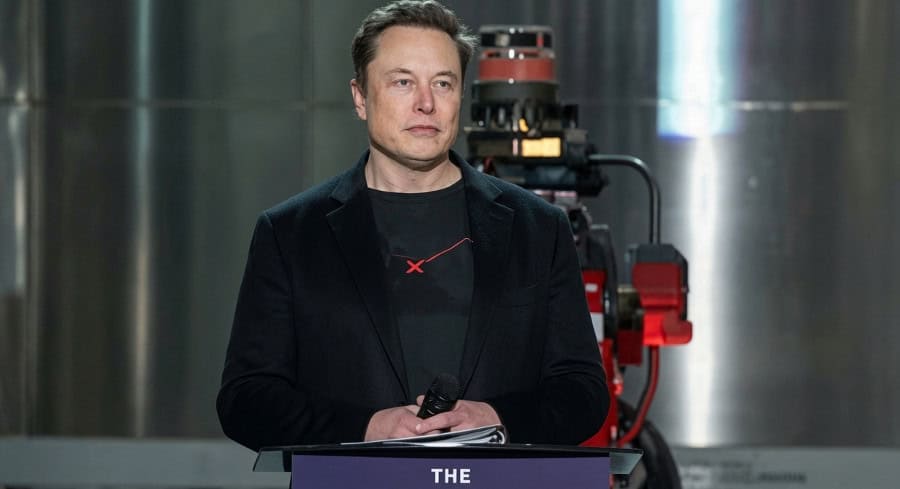
Elon Musk was reportedly furious to discover that Iranian forces tapped into his Starlink satellite network to help carry out strikes against American troops earlier this year, according to The Washington Post.
The exploitation occurred in the opening stages of the conflict, which began February 28 when the U.S. and Israel launched coordinated strikes across Iran under ‘Operation Epic Fury‘ to curb its nuclear program. Tehran responded by firing on American bases across the Middle East—a campaign that has claimed the lives of 23 U.S. service members, according to updated Pentagon figures released last month.
Two people familiar with internal SpaceX discussions told the Post that Musk was ‘enraged’ when he learned Iran had used the commercial satellite system to coordinate attacks on U.S. forces. Four additional sources confirmed that Tehran relied on Starlink to support its military operations.
A classified war briefing delivered to Secretary of War Pete Hegseth detailed how Iran used the network for command-and-control communications and to direct attack drones, the newspaper reported. When reached for comment on Saturday, Pentagon Press Secretary Kingsley Wilson said via email that the department was unaware of any report made to the Office of the Secretary of Defense and declined to address whether Iran had used Starlink.

The revelations highlight growing friction between SpaceX and the Pentagon over how commercial satellite technology is used in active combat zones. According to two anonymous sources cited by the Post, Musk also learned in early March that the U.S. military had been flying one-way drones using Starshield—the military-grade version of Starlink—while paying only for a lower-tier service plan restricted to ground operations.
The report comes just days after the Federal Communications Commission approved a SpaceX proposal to deploy up to 1 million satellites for orbital artificial intelligence data centers, which will integrate with the company’s existing 11,000-satellite Starlink constellation.
Musk has repeatedly insisted that Starlink is strictly a civilian network whose terms of service prohibit use in offensive weapons, urging the U.S. and allied militaries to rely on Starshield instead. That stance drew scrutiny last month when Ukrainian officials reported that Musk imposed restrictions on Starlink that slowed drone operations and disrupted frontline missions—a turn for a system that has served as a vital communications lifeline for Ukraine since Russia’s 2022 invasion.
Defending his policy in an October post on X, Musk responded to a user who warned that Russia might target Starlink satellites if it viewed the network as ‘weaponized and fair game.’

‘It can be used for infrastructure that is military, but it cannot be used for unequivocally offensive strikes that make it fair game to be struck back,’ Musk wrote. ‘An adversary blowing up Starlink satellites would create a domino effect of destruction that would generate a vast field of debris making space unusable.’
Even before the Ukraine restrictions, SpaceX had faced competing requests from Washington over where to turn the network on or off, according to Reuters.
Former President Joe Biden’s administration previously asked SpaceX to disable service to cut off communications for Iranian-backed militias in Yemen and Lebanon, while requesting active coverage inside Iran and Ukraine. President Donald Trump’s administration similarly asked Musk to keep internet access running for anti-government protesters inside Iran.
As commercial satellites play an increasingly central role on modern battlefields, security analysts say Washington and private aerospace firms face mounting policy dilemmas over how to balance global connectivity with national security.
Add The Tampa Free Press As A Preferred Source On Google
Please make a small donation to the Tampa Free Press to help sustain independent journalism. Your contribution enables us to continue delivering high-quality, local, and national news coverage.
