
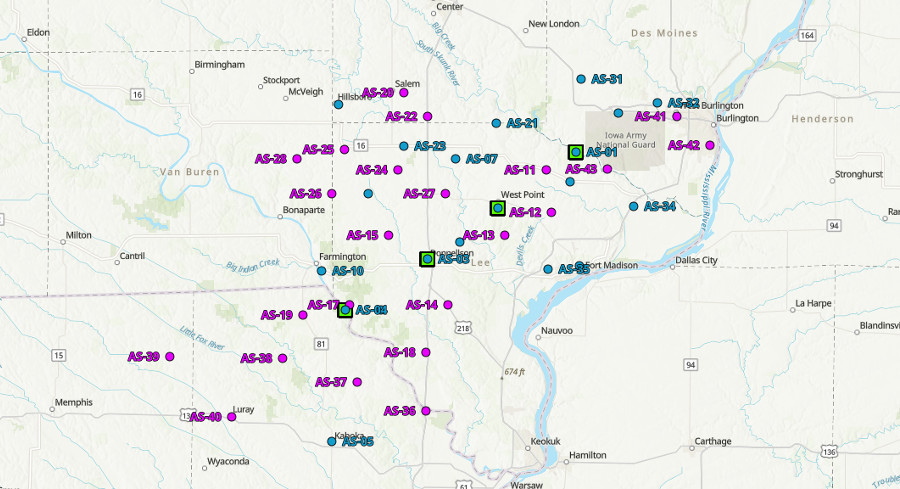
One hour after the U.S. Army carried out a controlled, mitigated detonation of unstable lead azide at the Iowa Army Ammunition Plant in Middletown, Iowa, real-time air monitors run by the U.S. Environmental Protection Agency reported no detectable airborne lead across the region. Officials said the agency’s monitors collected data continuously before, during, and after the blast.
The detonation took place around 9 a.m. Central Time on Wednesday, November 25, 2026, following three postponements caused by court challenges and shifting weather forecasts. The Army destroyed roughly five tons—or 68 barrels—of degraded, crystallized lead azide, a primary explosive used in detonators. Military officials warned that dropping autumn temperatures below 30 degrees Fahrenheit increased the risk of the aging stockpile exploding on its own in an uncontrolled chain reaction.
To contain the blast and limit lead dust from drifting into nearby communities, crews surrounded the site with two-story sand barriers, water walls, ballistic gel blocks, and aqueous foam, while saturating the surrounding soil with misters. Officials also timed the operation for winds blowing southwest, away from the city of Burlington and the Mississippi River.
Ahead of the explosion, environmental groups including the Sierra Club and the Iowa Environmental Council had sued to pause the operation over concerns that a toxic lead plume could travel up to 100 miles, before a federal appeals court cleared the Army to proceed earlier in the week.

Before the morning blast, the EPA gathered 1,200 baseline samples of air, land, dust, and water to establish local conditions. Roughly 300 EPA staff members and contractors were stationed on site in advance to track environmental impacts.
“Over the course of the upcoming minutes, hours, and days, EPA’s 300 employees and contractors, who have been pre-positioned on the ground, will be conducting extensive and thorough monitoring, taking samples of air, land, and water, and deploying remediation efforts if necessary,” EPA Administrator Lee Zeldin said in a statement. “In anticipation of the Army’s controlled detonation this morning, EPA placed the full force of the agency behind our effort to ensure we are doing everything possible to protect human health and the environment. This included the collection of 1,200 samples of air, land, dust, and water prior to this morning’s controlled detonation. We stand ready to provide any and all necessary support.”
State and local officials had issued precautionary advisories urging residents in the projected downwind path to stay indoors with windows and doors closed. According to the EPA, teams will continue testing air, soil, and water over the coming hours and days, expedite lab analysis, and carry out cleanup measures if monitoring shows a need. EPA monitoring data is made public as new readings become available.
Add The Tampa Free Press As A Preferred Source On Google
Please make a small donation to the Tampa Free Press to help sustain independent journalism. Your contribution enables us to continue delivering high-quality, local, and national news coverage.
